
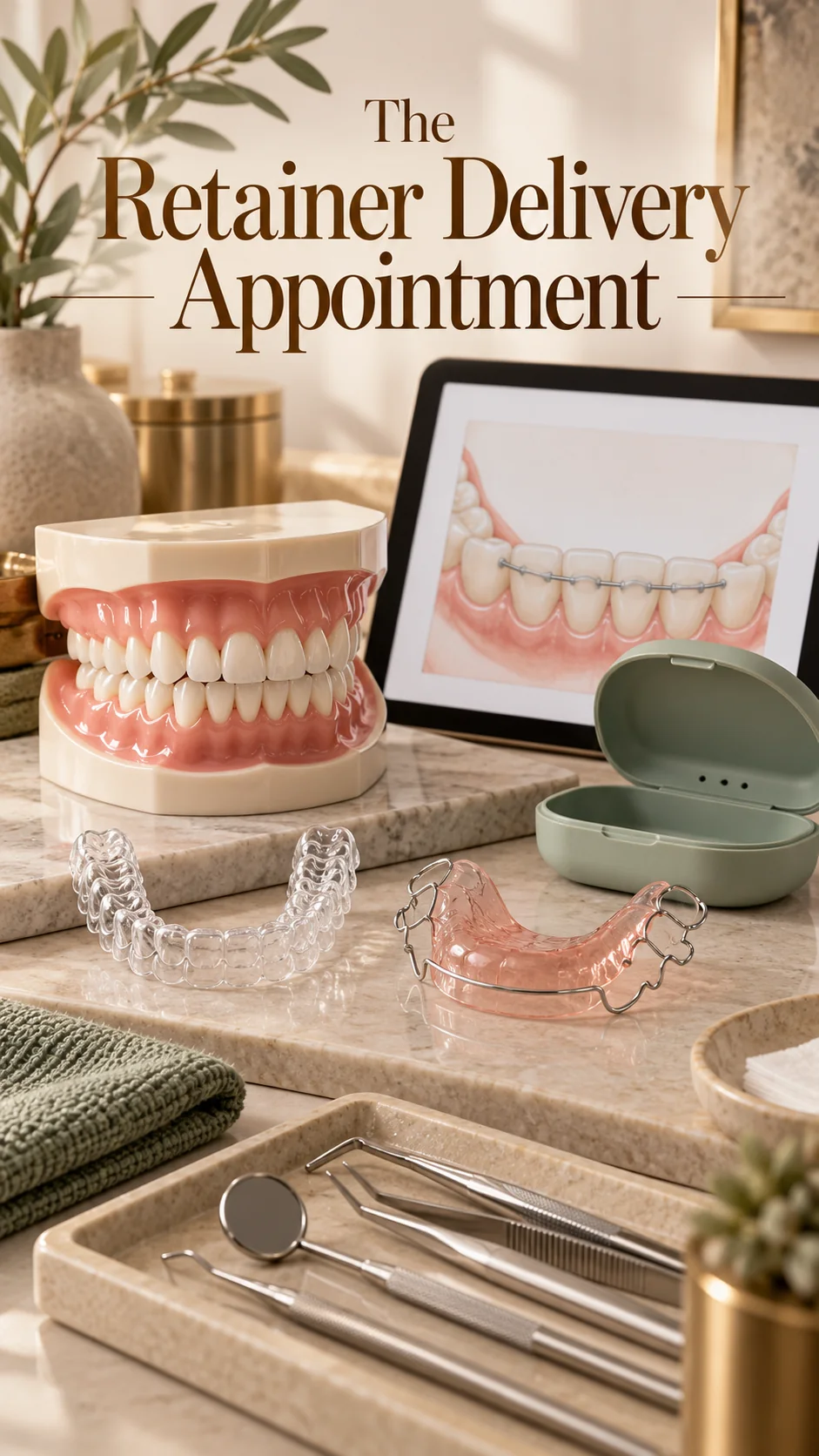
The Retainer Delivery Appointment
A beginner’s workflow for fit, instructions, documentation, and a confident handoff into retention
Made for This | Orthodontic Clinical Care Series | October 18, 2026
The finish line is really a handoff
Braces removal or the final aligner visit feels like a finish line, but it begins a new phase. The orthodontist’s retention plan helps hold the result while teeth and surrounding tissues adapt. For a beginning orthodontic support professional, delivery requires precision: the appliance, instructions, documentation, and follow-up must agree.
This is not a routine product pickup. The patient may be excited or anxious about keeping the result. The team should verify the treating clinician’s plan and make sure the patient can explain what happens next.
Before the patient sits down
Preparation begins with the chart. Confirm the retainer type, arch instructions, delivery date, planned wear schedule, follow-up interval, and fixed-retention notes. Ready the correct labeled case and education materials. Verify that scans, models, and photographs belong to the right patient and remain in the approved system.
Set up only the instruments and materials authorized for the planned visit. Reusable items that contact mucous membranes must be handled according to the practice’s infection-control process and manufacturer instructions. CDC guidance classifies many such dental items as semicritical and says heat-tolerant items should be heat sterilized; reprocessing belongs with trained personnel using appropriate protective equipment.
Fit is assessed, not guessed
Clear, Hawley, and fixed retainers share a purpose but do not look or feel the same. A removable retainer must match the ordered arch; a fixed retainer requires review of the wire, bonded areas, and hygiene access. Support staff observe and document, while the licensed treating professional determines fit, adjustment, and any plan change.
A useful sequence is simple: confirm the appliance, have the patient demonstrate insertion and removal if directed, ask what feels unusual, and let the orthodontist evaluate rocking, sharp edges, incomplete seating, bite change, or discomfort. Never force an appliance or label a painful fit “normal” without assessment. The AAO advises patients not to force a painful retainer that will not seat.
Teach the plan the patient actually has
Retainer schedules are individualized. Some patients are told to wear a removable retainer most of the day at first and transition later; others receive different instructions based on their case, stability, appliance type, or a fixed-and-removable combination. The support team should repeat the written plan approved by the orthodontist, not substitute a schedule remembered from another patient or found online.
Teach-back makes the instructions real. Instead of asking, “Do you understand?” try: “Show me how you will place and remove it,” or “Tell me when you will wear it and where you will store it when it is out.” If a caregiver is involved, include the patient in the conversation at an age-appropriate level. The ADA’s patient-autonomy guidance emphasizes meaningful involvement in treatment decisions, and its consent guidance describes informed consent as a dentist-patient conversation in which the patient can ask questions, even when trained staff help explain information.
Cleaning, storage, and the everyday routine
Education should match the retainer material and the office’s instructions. The AAO recommends routine cleaning, lukewarm rather than hot water for removable retainers, and storage in a case. Fixed retainers need careful cleaning around and beneath the wire. Products and methods should follow the orthodontist’s and manufacturer’s guidance.
Small routine questions often predict whether the patient will succeed: Where will the case live during lunch? What happens during sports? Who should be called if the appliance is left at school? A calm clinical support professional helps the patient build a realistic plan instead of delivering a speech that disappears as soon as the patient leaves.
Know what deserves a prompt call
Patients should contact the orthodontic office when a retainer is lost, cracked, distorted, sharp, painful, no longer seats, or suddenly feels different, and when they notice tooth movement, bite changes, ongoing discomfort, swelling, or a damaged fixed wire. These reports do not authorize support staff to diagnose relapse, prescribe pain care, bend a wire, or direct a wear change independently. Record the patient’s words, screen for urgent symptoms under the office protocol, and route the question to the treating orthodontist or another authorized clinician.
Illustrative language can keep the boundary clear: “I’m documenting that the retainer no longer seats on the left side. Please do not force it. I’ll send this to the treating team so they can tell you the appropriate next step.” The statement is helpful without pretending the caller has already been examined.
Documentation, consent, and privacy
A strong note identifies which retainer was delivered, the clinician who evaluated it, the wear and care instructions provided, the patient’s demonstration or questions, any secure images or scans reviewed, and the planned follow-up. If the patient or caregiver declines a recommended step, document the conversation and involve the dentist or orthodontist according to policy. Do not backfill the chart from memory at the end of a busy day.
Retainer photographs, scans, and messages remain patient information. The ADA notes that covered dental practices need reasonable safeguards for patient information in paper, photo, radiograph, oral, and electronic formats. Use approved systems, verify recipients, and avoid personal devices or casual messaging channels.
Scope is part of professionalism
“Orthodontic clinician” is a series label, not a nationally standardized license or independent credential. Licensed treating professionals diagnose, prescribe, select treatment, and direct changes. Support staff follow state law, their credentials, delegated duties, supervision, and office policy. DANB is a useful starting point, but candidates should verify current state-board rules.
Ohio provides one example, not a national rule. Revised Code section 4715.39 places most assistant procedures under a licensed dentist’s direct supervision and responsibility and does not authorize delegation of diagnosis, treatment planning, prescriptions, or authorization of orthodontic appliances. Retainer education must remain separate from clinical judgment.
What an employer may ask
An interviewer might say, “The retainer will not seat on delivery day. What do you do?” A strong beginner explains that they would stop the demonstration, listen without blaming the patient, verify the appliance and chart, document what they observe, and ask the treating clinician to evaluate the fit. They would not trim, bend, force, or independently approve the appliance.
Preparation for this work includes learning retainer vocabulary, practicing neutral chart notes, understanding secure photo handling, reviewing the office’s sterilization flow, and asking how state-specific duties are taught during onboarding. Reliability at this appointment is less about speed than about completing every handoff.
Guidebook roadmap: Part 6
This is Part 6 of the developing Orthodontic Clinical Care roadmap. Earlier parts cover the pathway, comfort, first visits, adjustments, and appliance problems. Future editions will address aligner check-ins, sterilization, privacy, anxious-patient communication, and interviews. This roadmap is editorial planning only; no guidebook publication is claimed.
The practical takeaway
A well-run retainer delivery appointment joins five things: the correct appliance, a clinician-confirmed fit, instructions matched to the actual plan, patient teach-back, and a documented follow-up path. When those pieces align, the patient leaves with more than a case—they leave knowing how to protect the result and when to ask for help.
If you are building your own orthodontic clinical-care study plan, browse the Made for This guides and learning resources at https://madeforthisblog.web.app/shop.html, then rehearse today’s delivery workflow as an interview scenario or onboarding checklist.
— — —
Sources
American Association of Orthodontists — “What to Expect After Your Braces Come Off” (September 16, 2026): https://aaoinfo.org/whats-trending/what-to-expect-after-braces-removal/
American Association of Orthodontists — “What Are Dental Retainers?” (June 3, 2025): https://aaoinfo.org/whats-trending/what-are-dental-retainers/
American Association of Orthodontists — “How to Clean Your Retainer at Home” (June 5, 2025): https://aaoinfo.org/whats-trending/how-to-clean-your-retainer/
Centers for Disease Control and Prevention — Sterilization and Disinfection (updated May 15, 2024): https://www.cdc.gov/dental-infection-control/hcp/summary/sterilization-disinfection.html
American Dental Association — Patient Autonomy and Confidentiality: https://www.ada.org/about/principles/code-of-ethics/patient-autonomy
American Dental Association — Types of Consent: https://www.ada.org/resources/practice/practice-management/types-of-consent
American Dental Association — HIPAA 20 Questions: https://www.ada.org/resources/practice/legal-and-regulatory/hipaa/hipaa-20-questions
Dental Assisting National Board — Ohio Dental Assistant Requirements: https://www.danb.org/state-requirements/detail/ohio-state-requirements
Ohio Revised Code § 4715.39 — Permitted Duties (effective December 29, 2023): https://codes.ohio.gov/ohio-revised-code/section-4715.39