
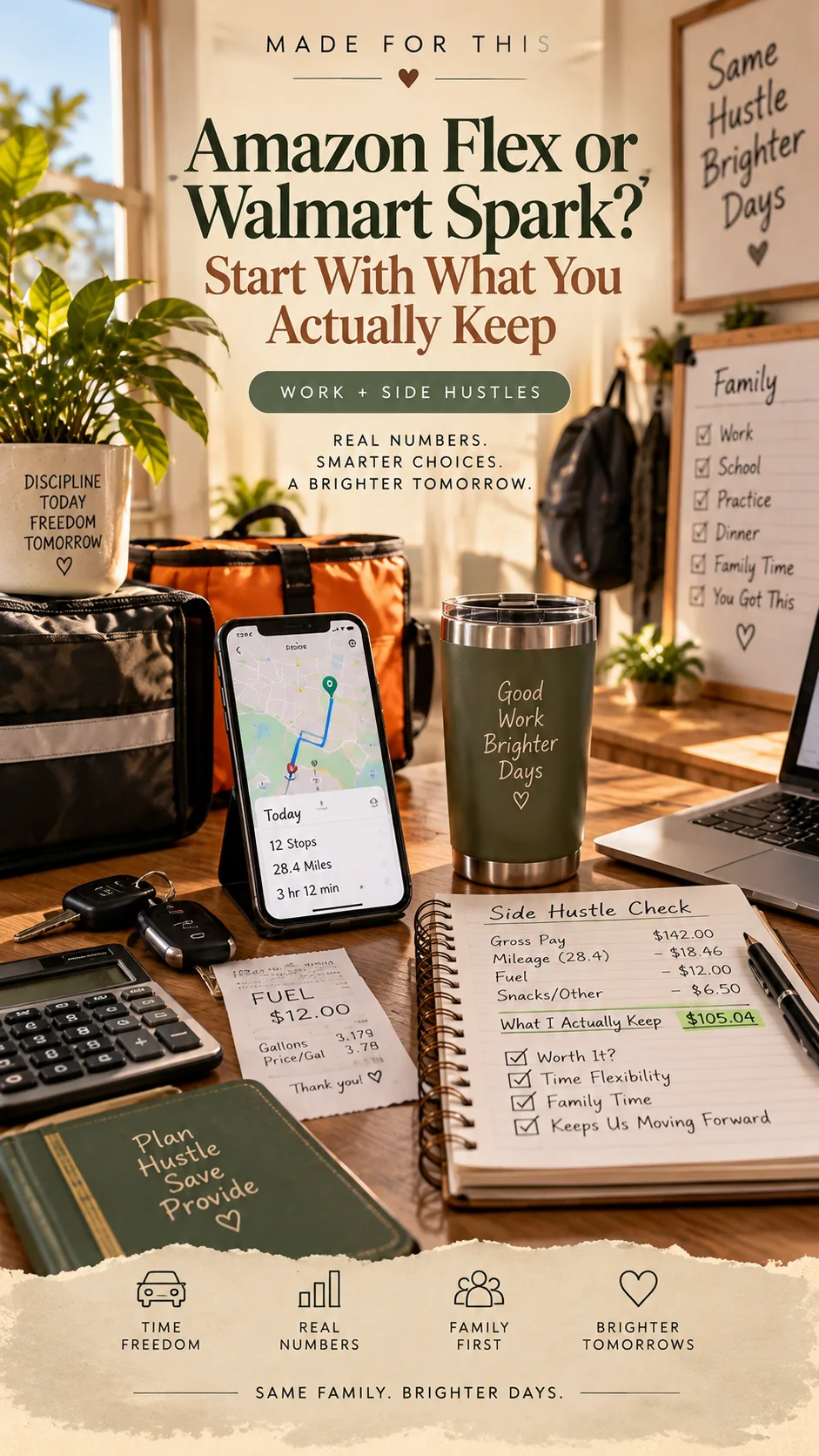
Amazon Flex or Walmart Spark? Start With What You Actually Keep
MADE FOR THIS | Work + Side Hustles
A delivery offer can look attractive on a phone screen and feel very different after the drive home. The useful question is not only 'What does this pay?' It is 'What will I keep for all the time and vehicle use this requires?' Amazon Flex and Walmart Spark can be worth investigating as side-hustle options, but the decision needs local numbers and a realistic trial.
Understand the basic setup
Amazon Flex commonly organizes work around delivery blocks, while Spark presents available delivery and shopping offers through its app. Details and availability depend on the location and offer. Amazon's recruiting page lists a minimum age of 21 and vehicle and insurance requirements; Spark's sign-up information lists a minimum age of 18 and its own enrollment requirements. Both require eligibility checks. Applying does not guarantee immediate access to work. Read the current official pages and your in-app terms before planning income around either platform. [1, 2, 3]
Compare the whole trip
For your personal planning, include the time getting to pickup, waiting, loading, shopping when required, making deliveries and returning to a useful stopping point. Count the miles your decision adds, including an empty return when relevant. These planning totals are not a statement that every minute or mile is tax deductible. An offer ending far from home can have a very different value from an equally paid offer ending nearby.
Use a clearly labeled practice example
Imagine a completed run brings in $60. It takes three hours in total and adds 40 miles. Using an assumed vehicle-cost allowance of $0.35 per mile gives $14 of vehicle costs; add $2 in parking. That leaves $44 before taxes, or about $14.67 per hour across the three hours. These are hypothetical inputs, not platform pay estimates. The vehicle allowance is a planning assumption, not the IRS mileage deduction rate.
Give your car a real place in the budget
Fuel is visible; maintenance, tires and vehicle wear are easier to ignore. Choose a reasonable method for estimating your vehicle costs and keep it consistent. If your per-mile estimate already includes fuel, do not subtract the same gas again. Add other out-of-pocket costs that affect your household decision. Before accepting delivery work, ask your insurer whether your policy covers that use and what additional coverage may be needed.
Run a small trial before making big plans
Try two manageable work sessions once approved and eligible. Record the final confirmed earnings, actual all-in time, miles and expenses. Keep an initial offered amount separate from the final payout, especially where tips or adjustments are involved. Compare the completed sessions with a minimum hourly amount that makes sense for your own circumstances. A busy promotional week does not establish a dependable annual income.
Treat taxes and account rules as part of the job
IRS guidance says gig income is taxable even when the work is part-time or no information form arrives. Keep income and expense records, and check whether estimated payments apply to you. Tax treatment depends on the facts; a tax professional can help you choose an appropriate approach. Use only your own authorized account, follow the platform's rules and handle app decisions while safely parked. [4, 5]
Let the numbers tell you what comes next
After a week, ask whether the work fits your energy, family schedule, vehicle and local demand. Continuing, changing the hours or deciding the fit is poor are all useful outcomes from a small trial. Download the five-page companion for an offer worksheet, worked example and session log. Build the side hustle around what you keep and what your household can sustain.
Companion guide
Open the five-page companion guide
Sources and further reading
[1] Amazon - Flex driver opportunities
[3] Spark - Earnings information