
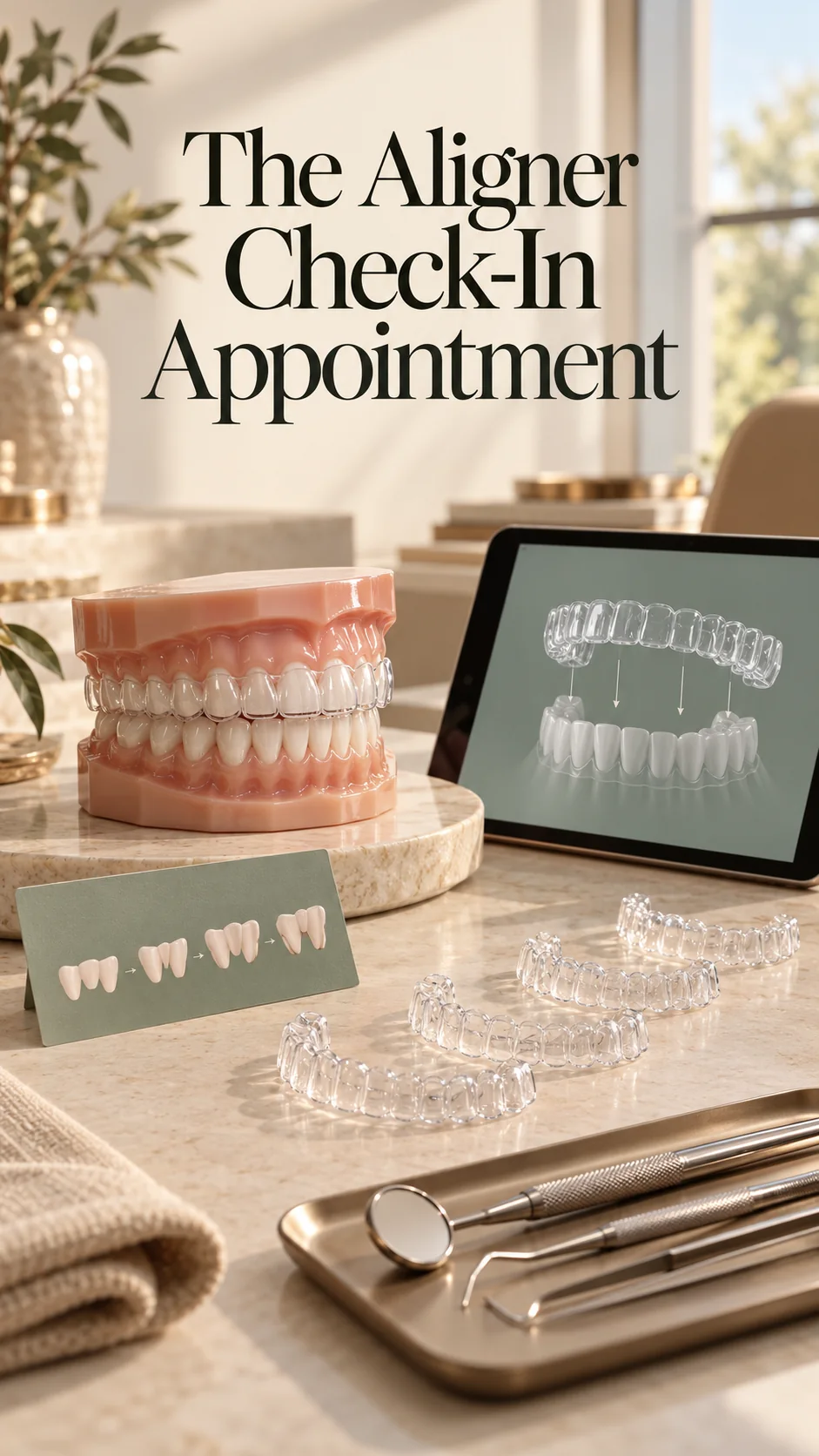
The Aligner Check-In Appointment
A beginner’s workflow for tray fit, patient communication, and clinician handoff
Made for This • Orthodontic Clinical Care • October 19, 2026
A clear-aligner check-in can look deceptively simple: the patient arrives, shows the current trays, and expects the next set. In a well-run orthodontic practice, however, the visit is a structured checkpoint. The team compares what is happening with the orthodontist’s plan, records useful observations, and routes questions to the licensed treating professional. For someone considering orthodontic clinical support work, this appointment shows how technical attention and calm communication belong together.
Prepare for the stage the patient is actually in
Before seating the patient, review the chart, the planned aligner stage, attachment or elastic instructions, recent messages, and any concerns documented at the previous visit. Confirm which tray the patient reports wearing and how long it has been in use, but do not assume the schedule is on track simply because a number appears in the chart. The American Association of Orthodontists describes aligners as a sequence of custom trays that move teeth in small increments; that makes the correct sequence and the orthodontist’s individualized directions clinically important.
Set up only the materials authorized for the planned visit, and protect clinical contact surfaces before the patient enters. If photos or a scan may be needed, confirm the office workflow, consent expectations, and secure destination for those records. Preparation creates a clean, accurate starting point for the licensed clinician’s evaluation.
Observe fit without turning observation into diagnosis
A support team member may be asked, within state law and the office’s delegation rules, to note whether a tray appears fully seated, whether an edge is lifted, whether the plastic is cracked or distorted, and whether attachments appear present. These are observations, not conclusions about why a tooth is or is not moving. Avoid statements such as “your treatment is off track” or “you need a refinement.” A safer handoff sounds like: “The upper tray appears to lift near the left canine, and the patient reports wearing it mainly at night.” The orthodontist then evaluates the finding and decides what comes next.
Ask about wear without blame
Patients sometimes arrive embarrassed because they forgot trays during travel, lost a set, shortened wear time, or found the routine difficult. A neutral question—“Walk me through when the trays are usually in and when they come out”—often produces better information than a lecture. Follow with specific prompts about meals, drinks, cleaning, elastics, soreness, and whether the tray ever felt unable to seat. Record the patient’s words accurately and avoid moral labels such as “noncompliant.” The goal is a reliable clinical picture, not a confession.
AAO patient guidance emphasizes wearing aligners as instructed, maintaining oral hygiene, and contacting the orthodontic office about a lost or poorly fitting appliance. Translate that principle into individualized teaching only after the orthodontist confirms the plan. Do not independently tell a patient to skip ahead, return to an older tray, extend a stage, double elastics, trim plastic, or change prescribed wear. Repeating the treating orthodontist’s documented instructions is support; inventing a new regimen is treatment planning.
Escalate discomfort and warning signs promptly
Mild pressure can occur during aligner treatment, but support staff should not diagnose the cause of pain, recommend medication, or promise relief. Pause and alert the treating clinician when a patient reports severe or worsening pain, facial swelling, fever, trauma, bleeding that does not stop, difficulty breathing or swallowing, or a tray that is badly cracked, distorted, or cutting tissue. AAO guidance distinguishes routine discomfort from urgent medical, dental, or orthodontic problems and advises patients to contact the orthodontic team rather than decide alone. Follow the office’s emergency protocol, and direct true medical emergencies to emergency services as required.
Keep attachments, elastics, and refinements in scope
Attachments and elastics may be part of an aligner plan, but their use is not interchangeable from one patient to another. A team member can verify what the chart says, prepare approved materials, observe and document what is present, and reinforce already-prescribed instructions when permitted. Bonding, removing, or altering attachments; changing elastic patterns; and deciding whether refinement scans or new trays are needed must remain with properly authorized personnel under applicable law and supervision. When uncertain, stop and ask the orthodontist instead of stretching a familiar routine into an unauthorized procedure.
Treat photos, scans, and surfaces as clinical work
Aligner visits often create highly identifiable records, including intraoral photographs and digital scans. Use only approved devices and software, verify the patient record before saving, and keep images out of personal phones, casual messages, and unapproved storage. The ADA notes that covered dental practices need reasonable safeguards for patient information in paper, photo, radiographic, oral, and electronic formats. Meanwhile, CDC guidance calls for barrier protection or cleaning and disinfection of clinical contact surfaces between patients and proper reprocessing of reusable items according to their classification and manufacturer instructions.
Know where the title ends and the legal scope begins
In this series, “orthodontic clinician” is an editorial umbrella for learning about orthodontic clinical care; it is not one nationally standardized license or a promise of independent practice. Orthodontists and other licensed treating professionals diagnose, treatment-plan, prescribe, and authorize care. Clinical support staff, assistants, and technicians work under roles that vary by state, credential, training, delegation, and supervision. DANB’s state pages are a useful starting point, but candidates should confirm current duties directly with the relevant state dental board and the employer.
Ohio offers a concrete example, not a nationwide rule. Ohio Revised Code §4715.39, effective December 29, 2023, says most dental procedures assigned to assistants or qualified personnel are performed under the licensed dentist’s direct supervision and full responsibility, with specified exceptions. The law also bars assignment of diagnosis and treatment planning or prescription, including authorization for orthodontic appliances. A job title on a badge does not override those limits.
An interview-ready scenario
Imagine that a patient’s upper tray is not fully seated and the patient quietly admits wearing it only at night for the past week. A strong beginner response is to thank the patient for being honest, ask neutral clarifying questions, document the reported wear and visible fit, and bring the orthodontist into the conversation. It is not to scold, guarantee that the delay is harmless, or choose a new tray schedule. In an interview, explain that you would protect privacy, stay within delegated duties, and communicate the facts concisely so the treating clinician can decide.
Practical takeaway
The best aligner check-in is not the one that moves fastest; it is the one that produces trustworthy information, a clean clinical environment, and a clear clinician decision. Beginners can practice three habits now: separate observation from interpretation, ask nonjudgmental questions, and escalate anything outside their authorization. Those habits help patients feel heard while keeping responsibility clear.
Orthodontic Clinical Care roadmap
This is Part 7 of a developing educational roadmap. Earlier installments covered the first appointment, adjustment visits, broken appliances, and retainer delivery; future parts will address sterilization workflow, anxious-patient communication, privacy, consent, and interview readiness. The roadmap is editorial planning, not an announcement that a guidebook has been published.
If this visit workflow helps you picture the work more clearly, browse the Made for This guides at https://madeforthisblog.web.app/shop.html and choose the next study step that fits your goals.
— — —
Sources
American Association of Orthodontists — Clear Aligners (accessed October 19, 2026): https://aaoinfo.org/treatments/aligners/
American Association of Orthodontists — What Your Orthodontist Wishes You Knew (published October 13, 2026; accessed October 19, 2026): https://aaoinfo.org/whats-trending/what-your-orthodontist-wishes-you-knew/
American Association of Orthodontists — What Is an Orthodontic Emergency? (February 16, 2026): https://aaoinfo.org/whats-trending/what-is-an-orthodontic-emergency/
Centers for Disease Control and Prevention — Sterilization and Disinfection (May 15, 2024): https://www.cdc.gov/dental-infection-control/hcp/summary/sterilization-disinfection.html
American Dental Association — HIPAA 20 Questions (accessed October 19, 2026): https://www.ada.org/resources/practice/legal-and-regulatory/hipaa/hipaa-20-questions
American Dental Association — Types of Consent (accessed October 19, 2026): https://www.ada.org/resources/practice/practice-management/types-of-consent
Dental Assisting National Board — Ohio Dental Assistant Requirements (accessed October 19, 2026): https://www.danb.org/state-requirements/detail/ohio-state-requirements
Ohio Revised Code §4715.39 — Permitted Duties (effective December 29, 2023; accessed October 19, 2026): https://codes.ohio.gov/ohio-revised-code/section-4715.39
— — —