Some family activities sound lovely until they require twenty minutes of setup, a trip to the store, and the energy to guide everyone through a complicated plan. By the time dinner is cleared and tomorrow’s bags are half-packed, even a simple craft can feel like one more thing to manage. The Five-Minute Story Sketch works because it begins small: one prompt, one quick drawing, and one sentence that turns the picture into a story.
The goal is not to produce polished art. It is to give everyone at the table a short way to notice, imagine, and laugh together before the evening moves on. Five minutes is long enough to begin but short enough that a tired parent, a reluctant older child, or a preschooler with a tiny attention span can all participate without feeling trapped.
Build a Tiny Drawing Kit
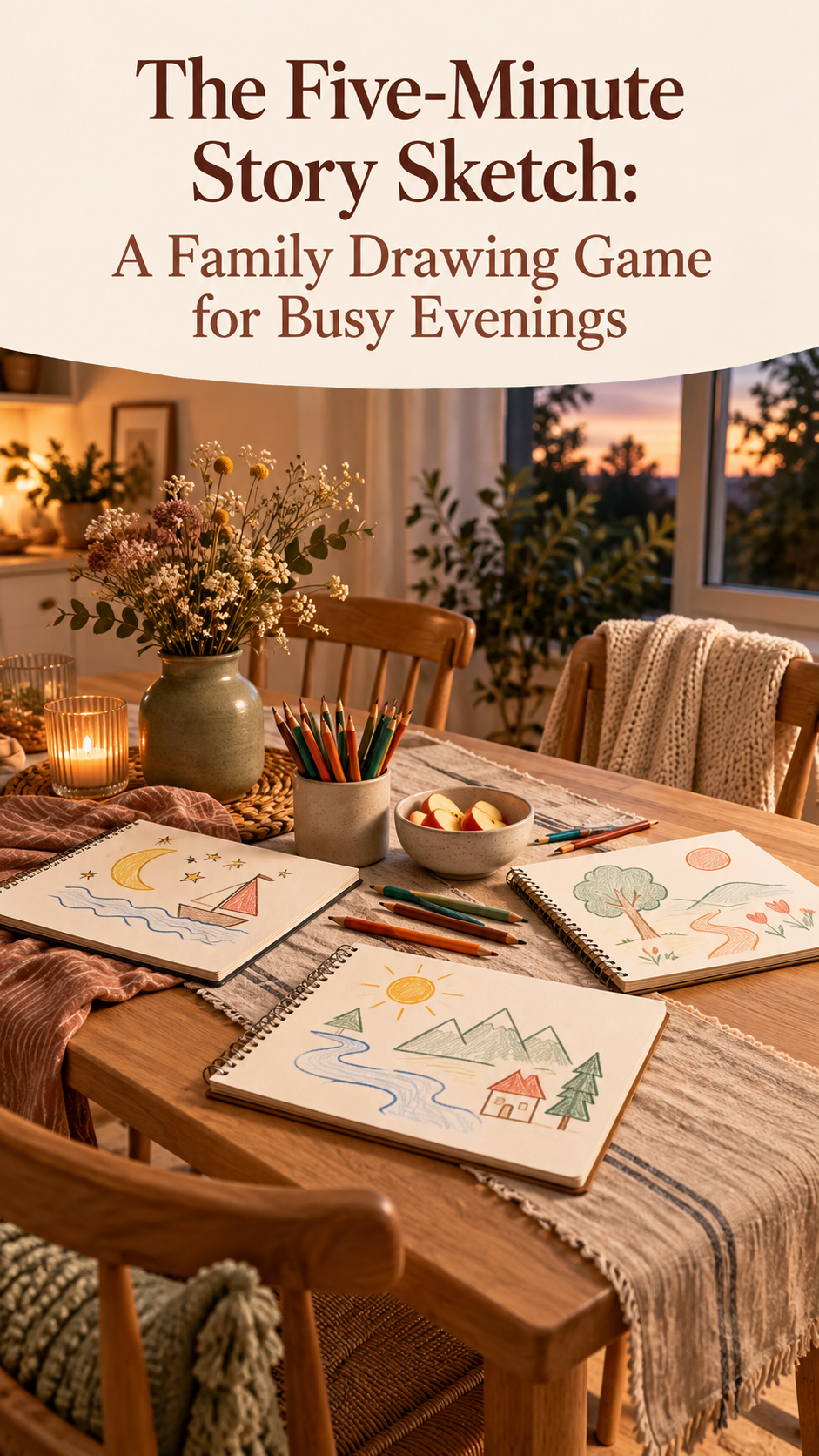
Keep the supplies simple enough that the activity can start almost immediately. A small basket with blank paper, a few sketchbooks, pencils, crayons, and washable markers is plenty. If the basket lives near the table, nobody has to hunt through closets or decide which materials are “good enough” for the moment.
Choose One Prompt With Room to Wander
A good prompt offers a beginning without deciding the whole picture. Try “a house in an unusual place,” “an animal with a surprising job,” “a tiny door,” “the view from a flying picnic blanket,” or “something that happened after the lights went out.” The prompt should be specific enough to spark an image but open enough that every page looks different.
If someone says they do not know what to draw, give two choices instead of a longer explanation. Ask, “Would your unusual house be underwater or in a tree?” or “Would your animal work at a bakery or drive a bus?” A choice gives the imagination something solid to push against while still leaving plenty of room for the child—or adult—to make the idea their own.
Set a Friendly Five-Minute Timer
Start the timer and let everyone draw at the same time. Adults should participate rather than supervise from the edge of the table, because a quick, imperfect grown-up drawing quietly gives everyone else permission to relax. No one needs to fill the page, and finishing early is allowed.
When the timer ends, put the pencils down gently instead of treating it like a competition. If someone wants one extra minute to add a final detail, the family can decide together. The timer exists to protect the activity from expanding into a project, not to create pressure.
Add the Story in One Sentence
Go around the table and let each person say one sentence about the picture. The sentence might explain who lives there, what just happened, what the character wants, or what happens next. A child who does not want to speak can point to a detail while someone else asks a simple question.
This is where the game often becomes memorable. A crooked line becomes a secret river, a round shape becomes a moon bakery, and three unrelated sketches suddenly belong to the same adventure. If the family wants, connect the sentences into one shared story—but stop while everyone is still enjoying it.
Make Space for Different Ages and Moods
Young children may draw a few shapes and name them afterward. Older children may add dialogue, invent rules for the world, or turn the page into a miniature comic. A tired adult may sketch only a cup and call it “the mug that refused to be washed,” which still counts.
The game also works when someone wants to watch instead of draw. They can choose the prompt, manage the timer, or ask the first story question. Participation does not have to look identical for the activity to feel shared, especially on evenings when energy and patience are uneven.
Resist the Urge to Correct
The fastest way to make a low-pressure drawing game feel like homework is to correct proportions, spelling, or realism while the page is still happening. If a purple sun makes sense in the story, let it shine. If a house has six doors and no windows, ask who uses each door rather than explaining how a house should look.
Praise what you genuinely notice instead of offering a broad “good job” to every page. You might say, “I like how the path disappears behind the mountain,” or “That tiny ladder makes me wonder who is climbing it.” Specific attention shows that the idea was seen without turning the drawing into a performance.
Let the Pages Become a Family Archive
Date the back of each page and place finished sketches in a simple folder. There is no need to display every drawing or save them forever, but a monthly stack can become a funny record of family interests, inside jokes, and changing imaginations. At the end of the month, each person can choose one favorite to keep.
Practical Takeaway
Tonight, place paper and a handful of drawing tools on the table, choose one open-ended prompt, and set a five-minute timer. Draw together, share one sentence per picture, and stop before the activity becomes another obligation. The win is not a perfect page; it is a small pocket of attention that everyone could enter.
Looking for another simple, no-pressure activity? Visit our Free Library to browse genuinely available free printables and samples.
If your family enjoys having a ready-made creative next step, browse the Made for This guides at https://madeforthisblog.web.app/shop.html and choose the resource that fits the kind of quiet, low-pressure activity your household wants more of.